Mostrar mensagens com a etiqueta Julian Barnes. Mostrar todas as mensagens

29/07/2011

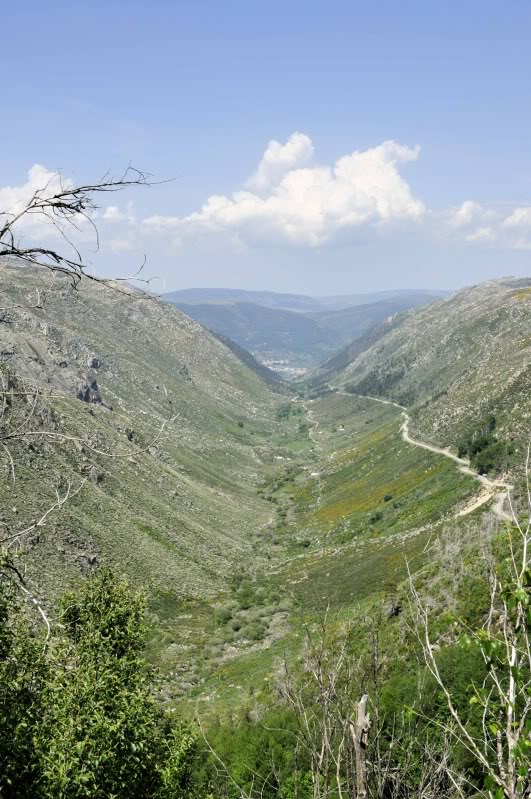
Vale do Zêzere


One of the many correct-until-next-week versions of the world that I was taught was Berkeley's. He held that the world of "houses, mountains, rivers and in a word all sensible objects" consists entirely of ideas, sensory experiences. What we like to think of as the real world, out there, corporeal, touchable, linear in time, is just private images – early cinema – unreeling in our heads. Such a world view was, by its very logic, irrefutable. Later, I remember rejoicing at Literature's reply to Philosophy: Dr Johnson kicking a stone and crying, "I refute it thus!". You kick a stone, you feel its hardness, its solidity, its reality. Your foot hurts, and that is proof. The theorist is undone by the common sense of which we are so Britishly proud.

The stone that Dr Johnson kicked, we now know, wasn't solid at all. Most solid things consist mainly of empty space. The earth itself is far from solid, if by solid we mean impermeable: there are tiny particles called neutrinos, which can pass right through it, from one side to the other. Neutrinos can pass – were passing – through Dr Johnson's stone without any trouble; even diamonds, our epitome of hardness and impermeability, are in fact crumbly and full of holes. However, since human beings are not neutrinos, and it would be distinctly pointless for us to try passing through a rock, our brain informs us that the rock is solid. For our purposes, in our terms, it is solid. This is not what is true, but rather what it is useful for us to know. Common sense raises utility into factitious but pratical truth.


Julian Barnes, Nothing to be Frightened of (Jonathan Cape, 2008)

17/06/2008

Campainhas-amarelas

«On Monday, Wednesday, Friday and Sunday, asserting her marital right to the fourth day out of seven, my mother visits him. She brings him grapes and the newspaper from the day before (...). She talks to him of their past time together, of their children and their shared memories.

On Tuesday, Thursday and Saturday, Elsie
[the mistress] visits my father. She brings him flowers and home-made fudge (...). She talks to him about the future, about how he is going to be better, and the life they will then have together.»

Julian Barnes, The lemon table (2004)


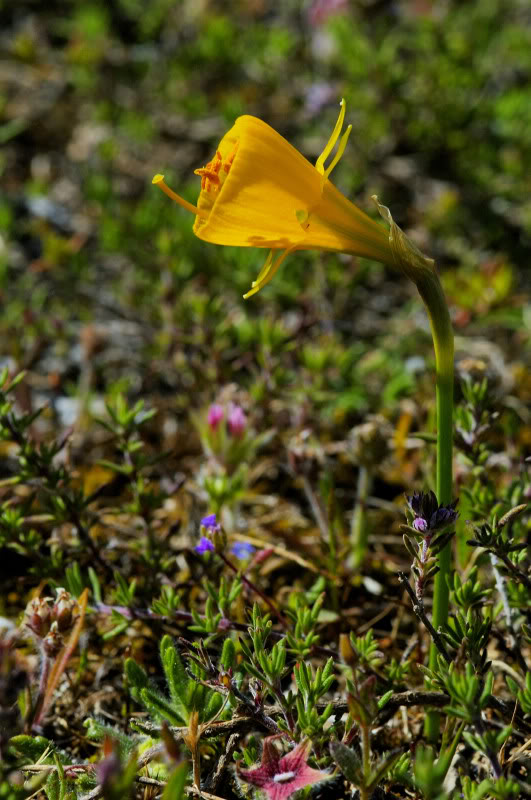
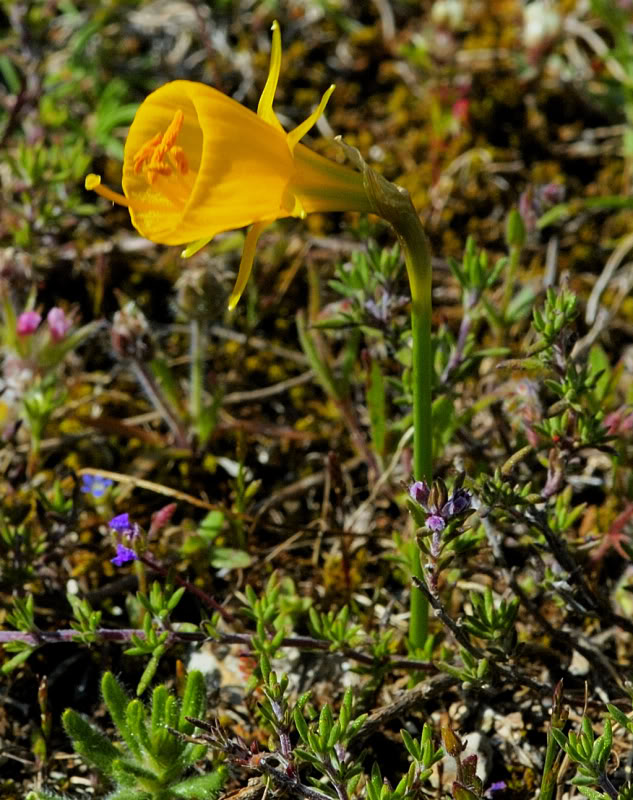
Narcissus bulbocodium subsp. obesus

Este é um narciso de distribuição limitada à Península Ibérica e Marrocos. No Parque Natural das Serras de Aire e Candeeiros (PNSAC) existe uma população numerosa que floresce de Janeiro a Março, com algumas flores para os visitantes atrasados de Maio. Está ameaçada pela exploração de inertes e por isso consta do livro «Plantas a proteger no PNSAC», de António Flor, publicado em 2005 pelo Instituto da Conservação da Natureza.

Herbácea vivaz e bulbosa, aprecia pastagens secas de solo rico em calcário, ou pouco ácido, acima dos 200m. Tem folhas estreitas, cilíndricas e compridas, erectas no caso do Narcissus bulbocodium, contorcidas na subespécie obesus que não se opõe a um chão mais alagado. As flores têm corola afunilada, um saiote em balão (como indica a designação hoop petticoat daffodil) com seis tépalas estreitas e pontiagudas a formar uma coroa de bracinhos na base. (O N. cantabricus, seu parente próximo do sudoeste da Península Ibérica, tem flores de igual formato mas brancas.) A polinizacão é assegurada sobretudo por abelhas e o fruto é uma cápsula com sementes redondas e pretas. Há cultivares de jardim com diferentes gradações de amarelo, como o amarelo-limão da variedade citrinus ou o amarelo-dourado das golden bells - realçando quão longínquos vão os tempos simplórios em que as cores se descreviam com uma só palavra.

Os horticultores agrupam as centenas de espécies, híbridos e cultivares do género Narcissus em treze secções de acordo com as características da flor e origem da planta, sendo doze reservadas a variedades de jardim e a décima-terceira para as espécies silvestres como a das fotos - que lhe oferecem, caro leitor atento, duas flores iguais e o prazer de identificar várias outras plantinhas minúsculas de que já aqui falámos.